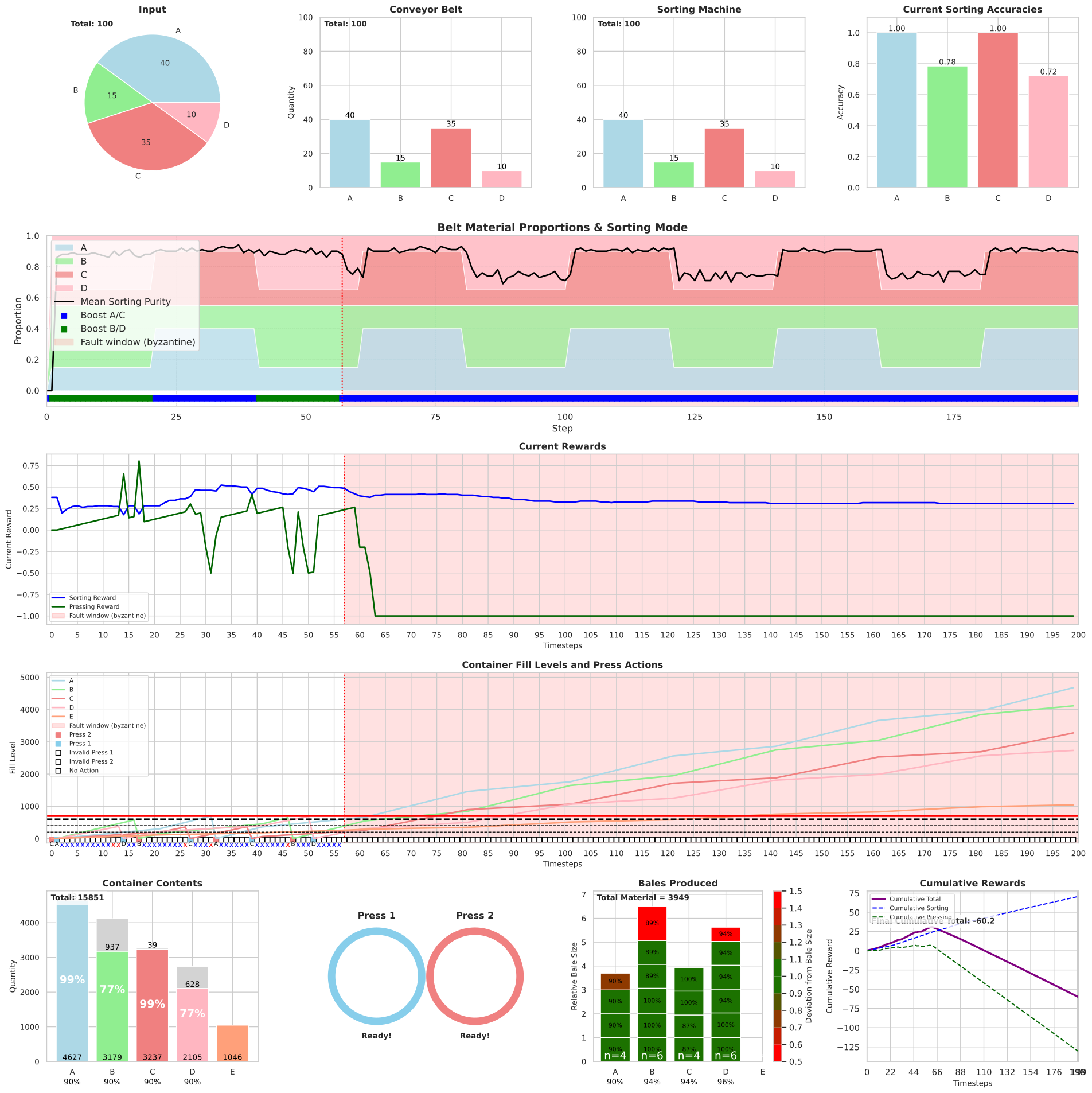
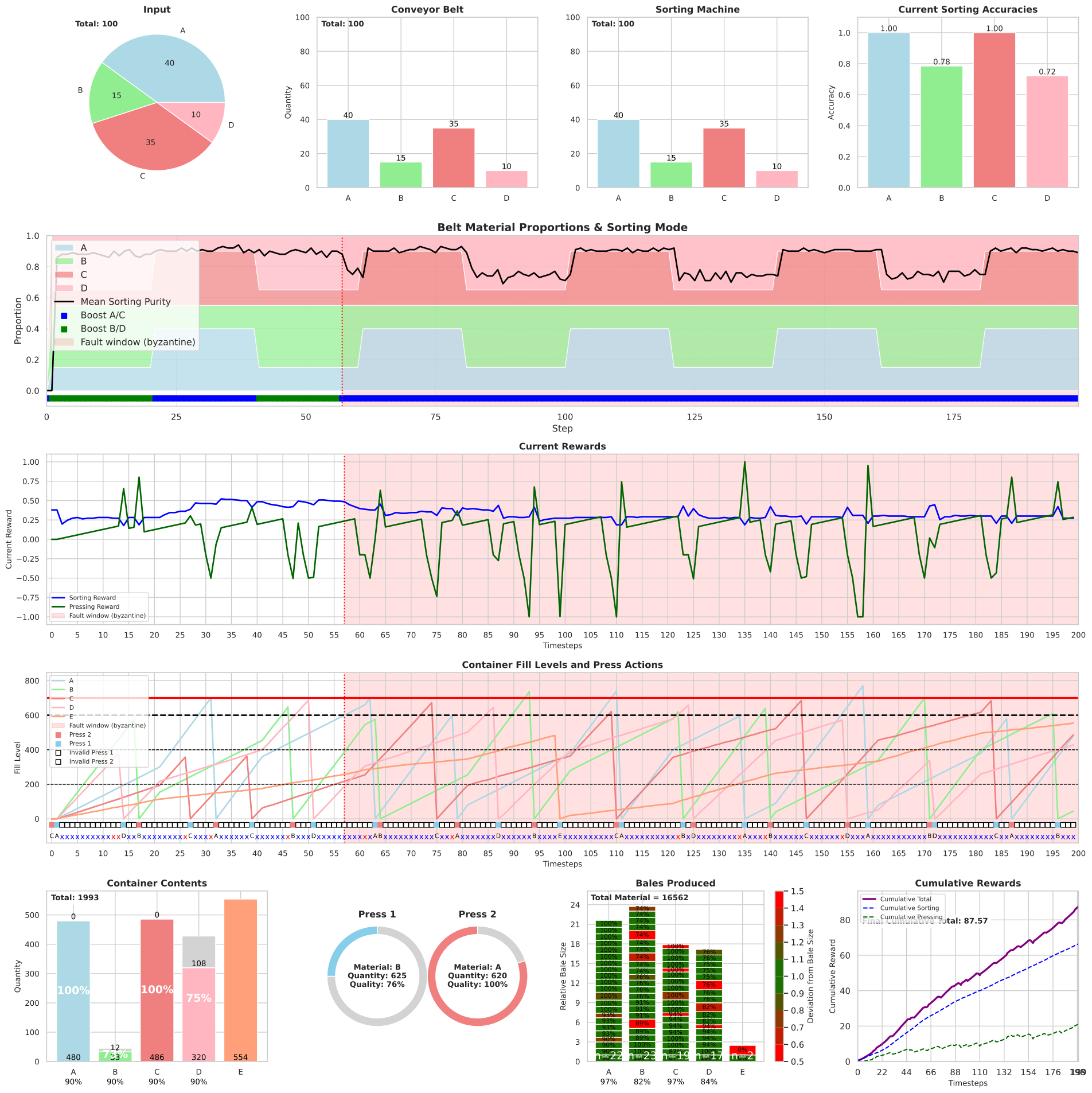
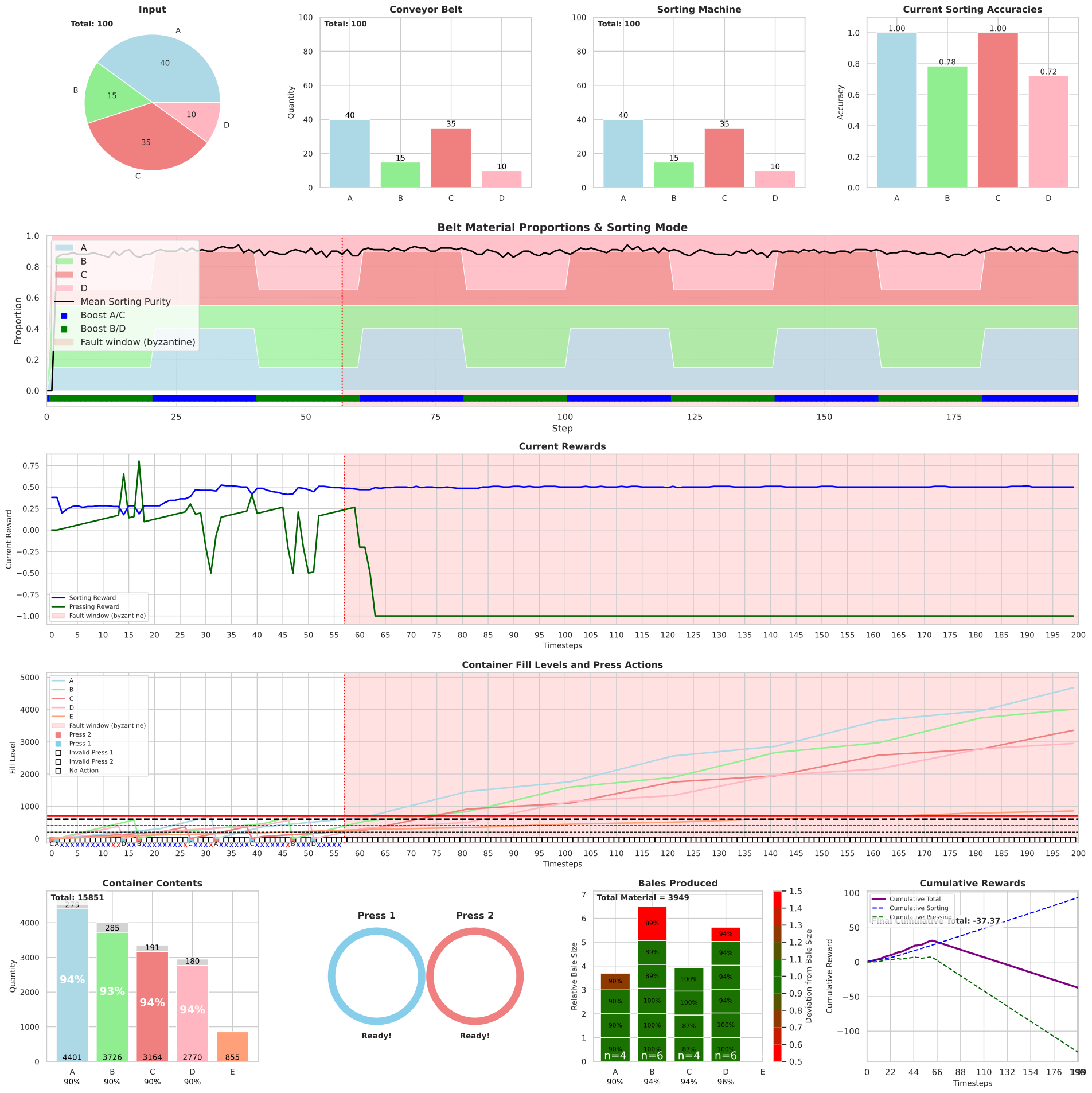
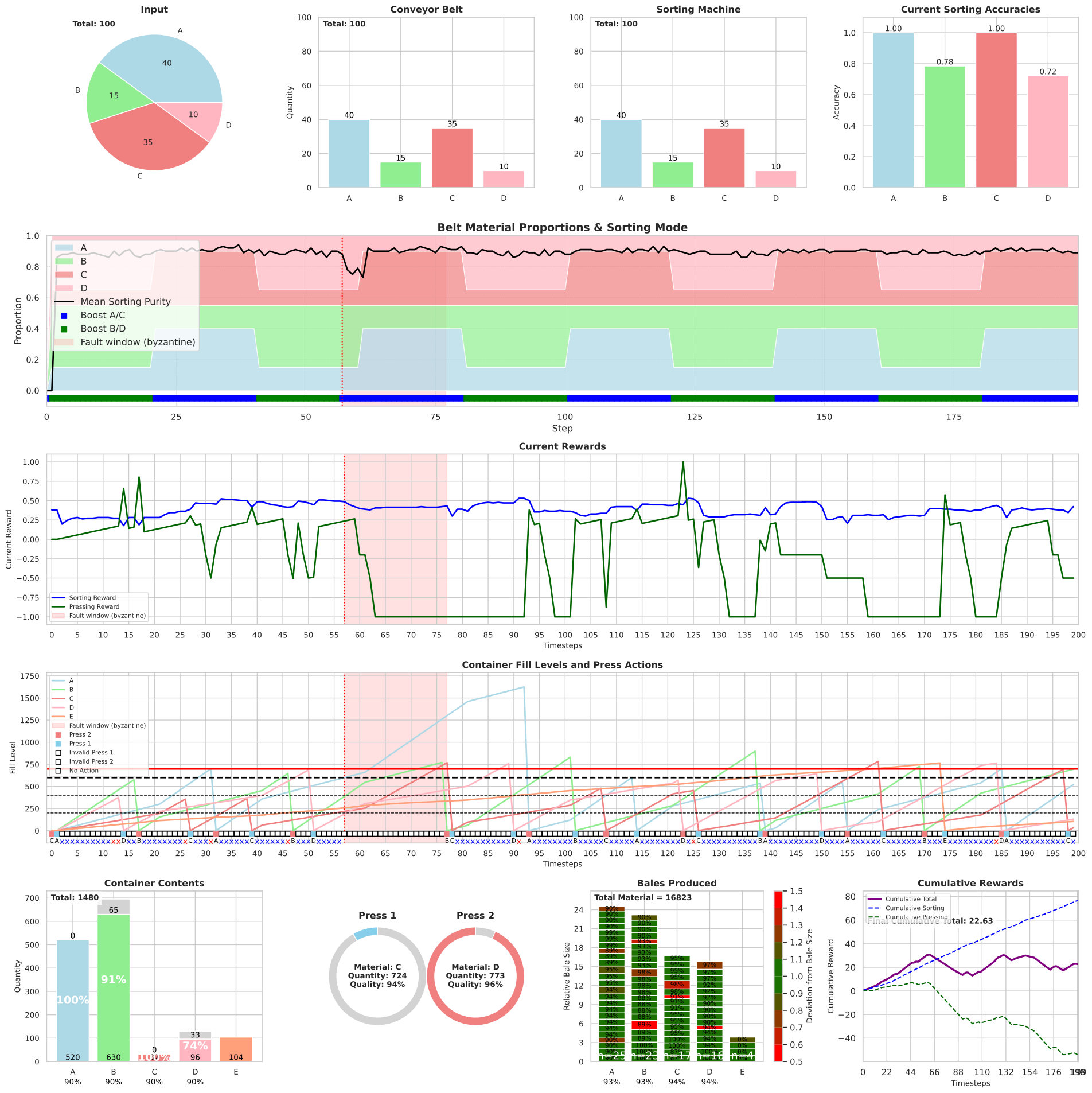
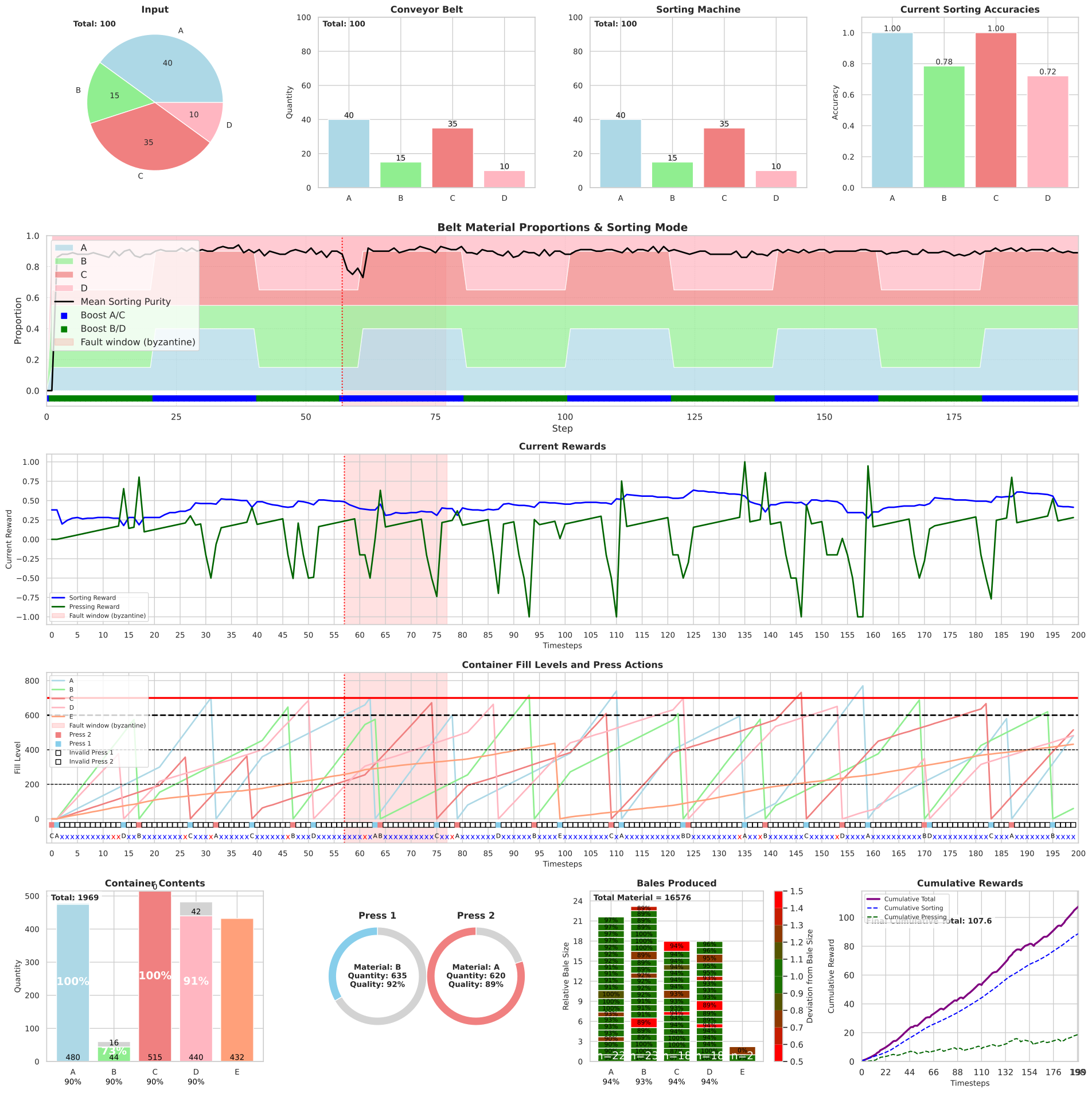
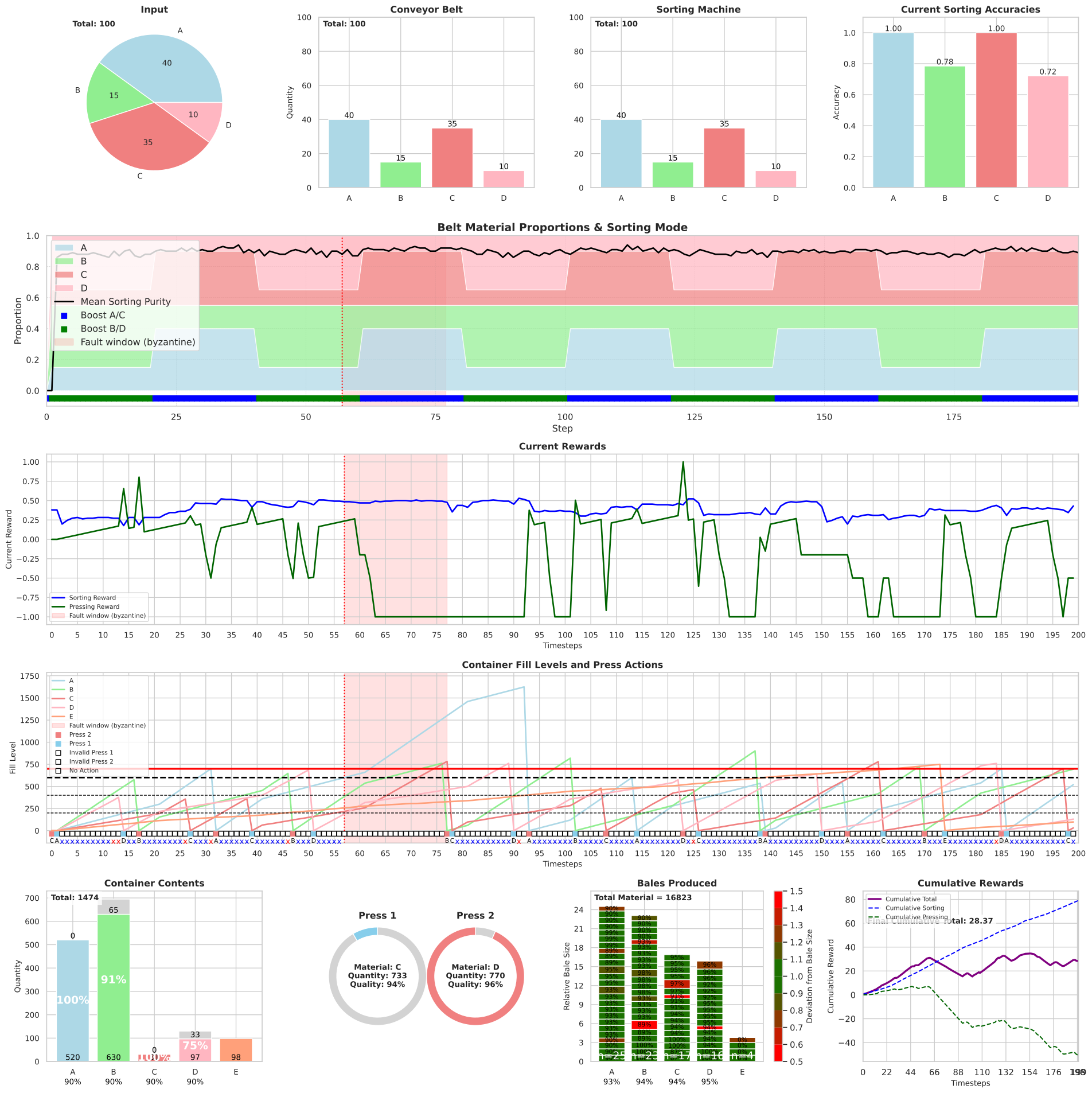
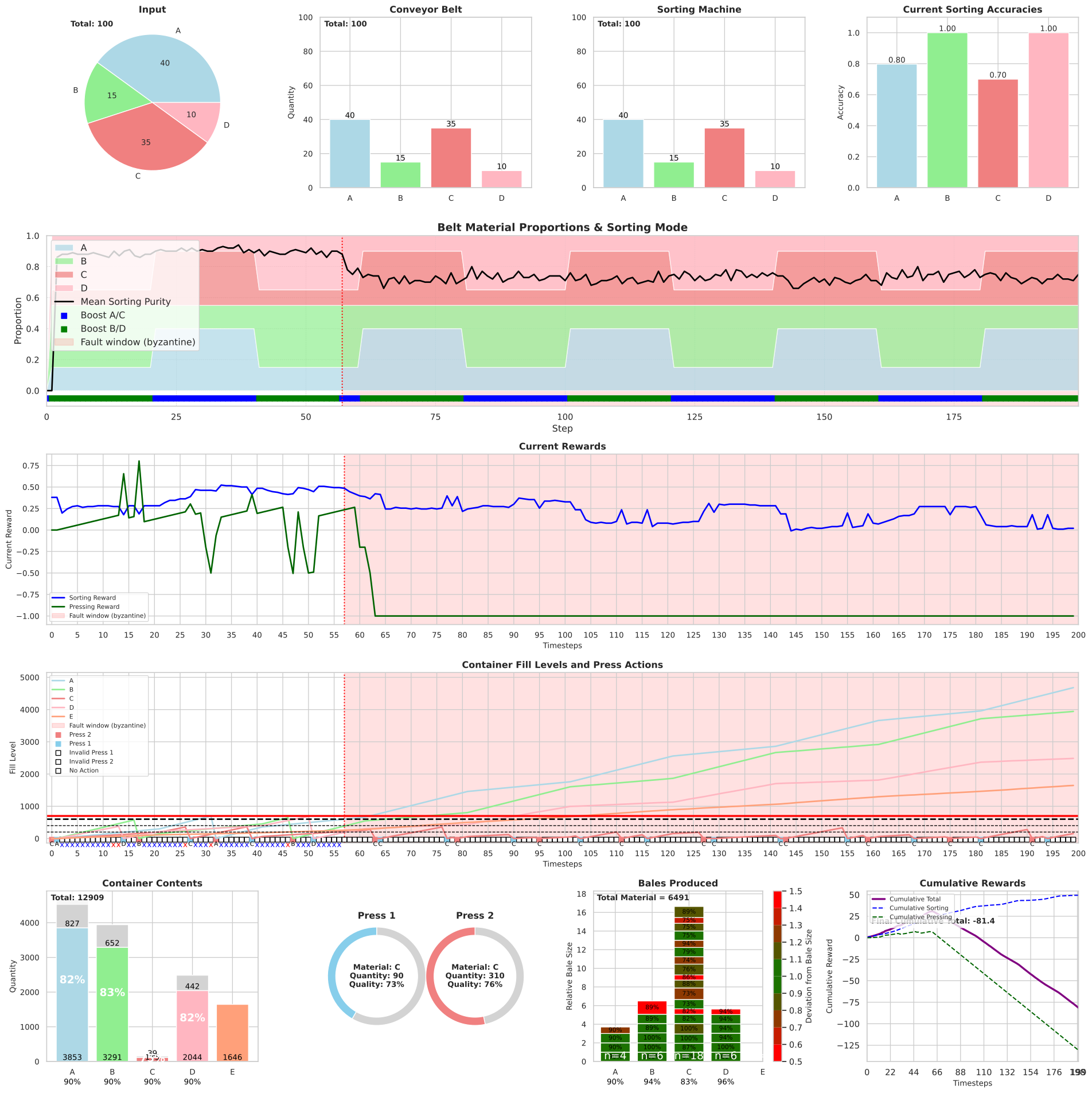
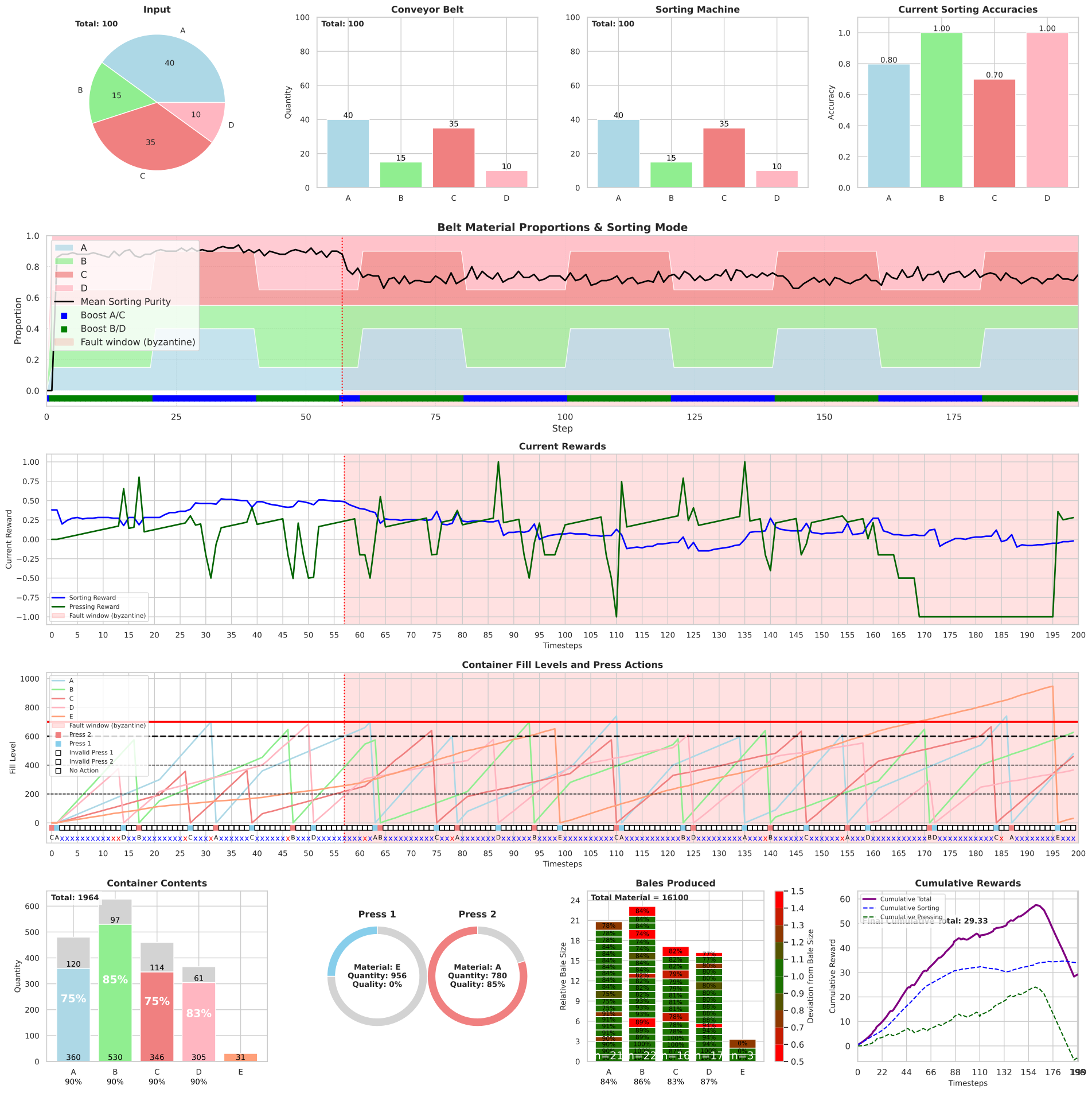
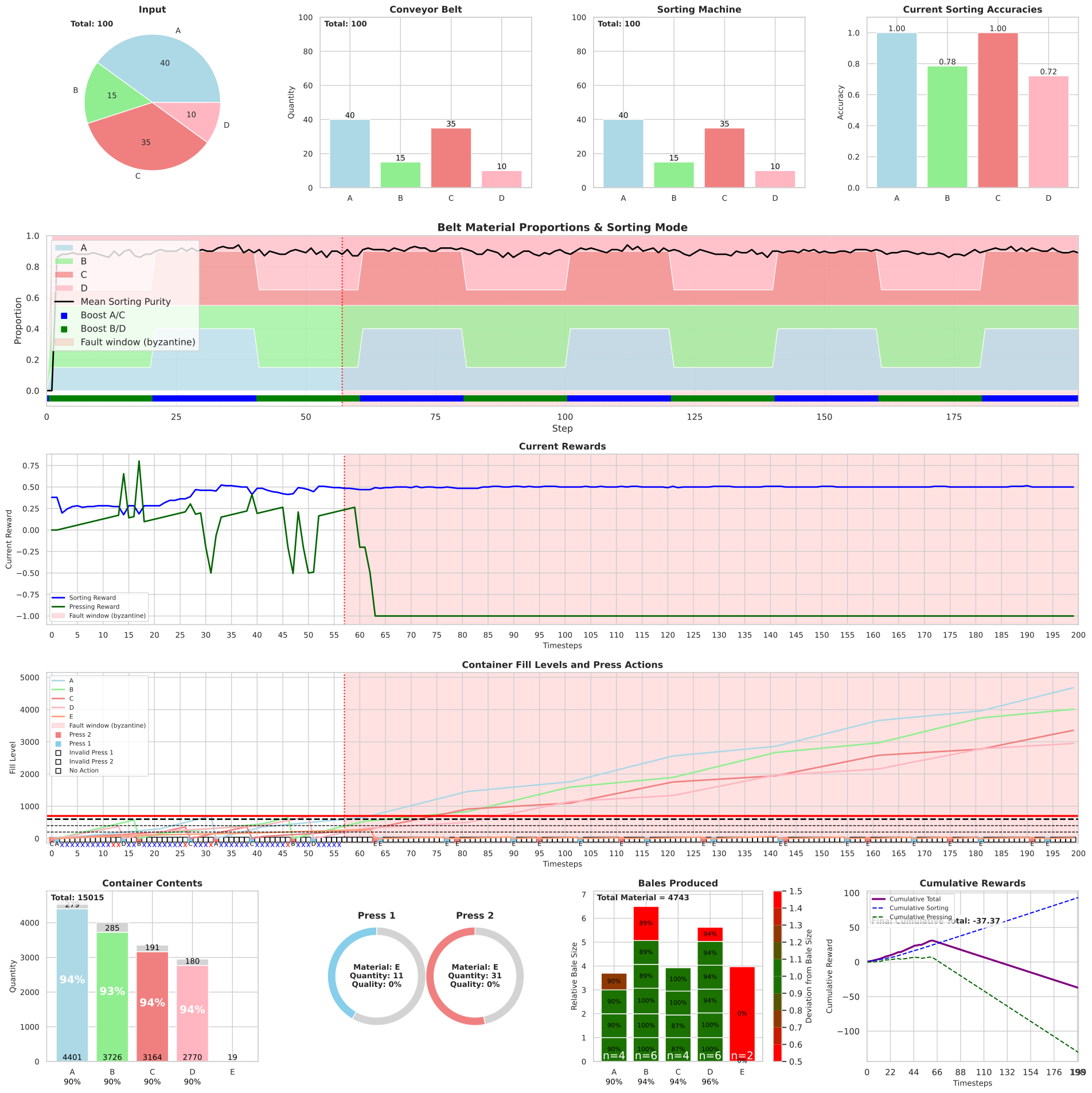
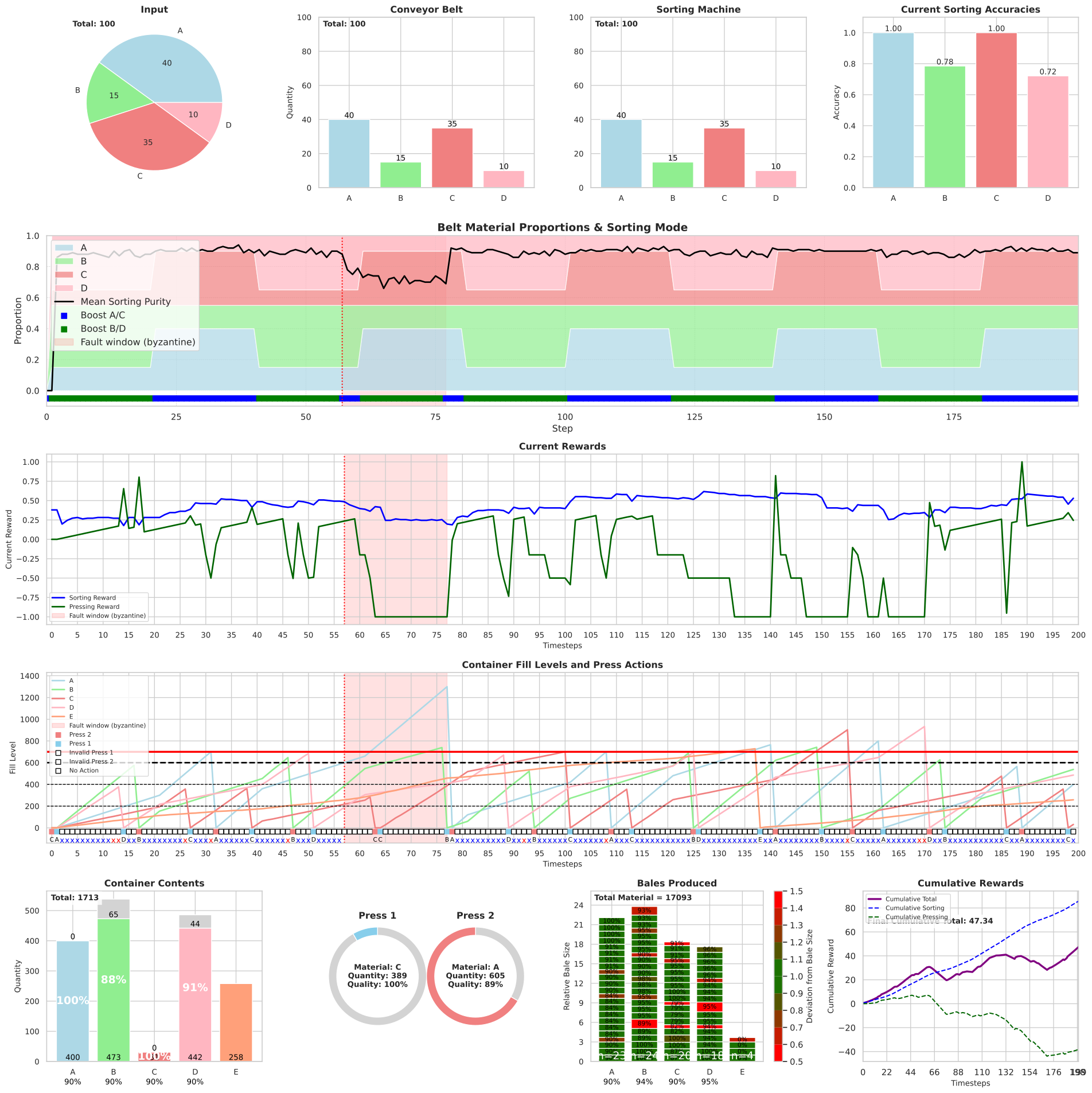
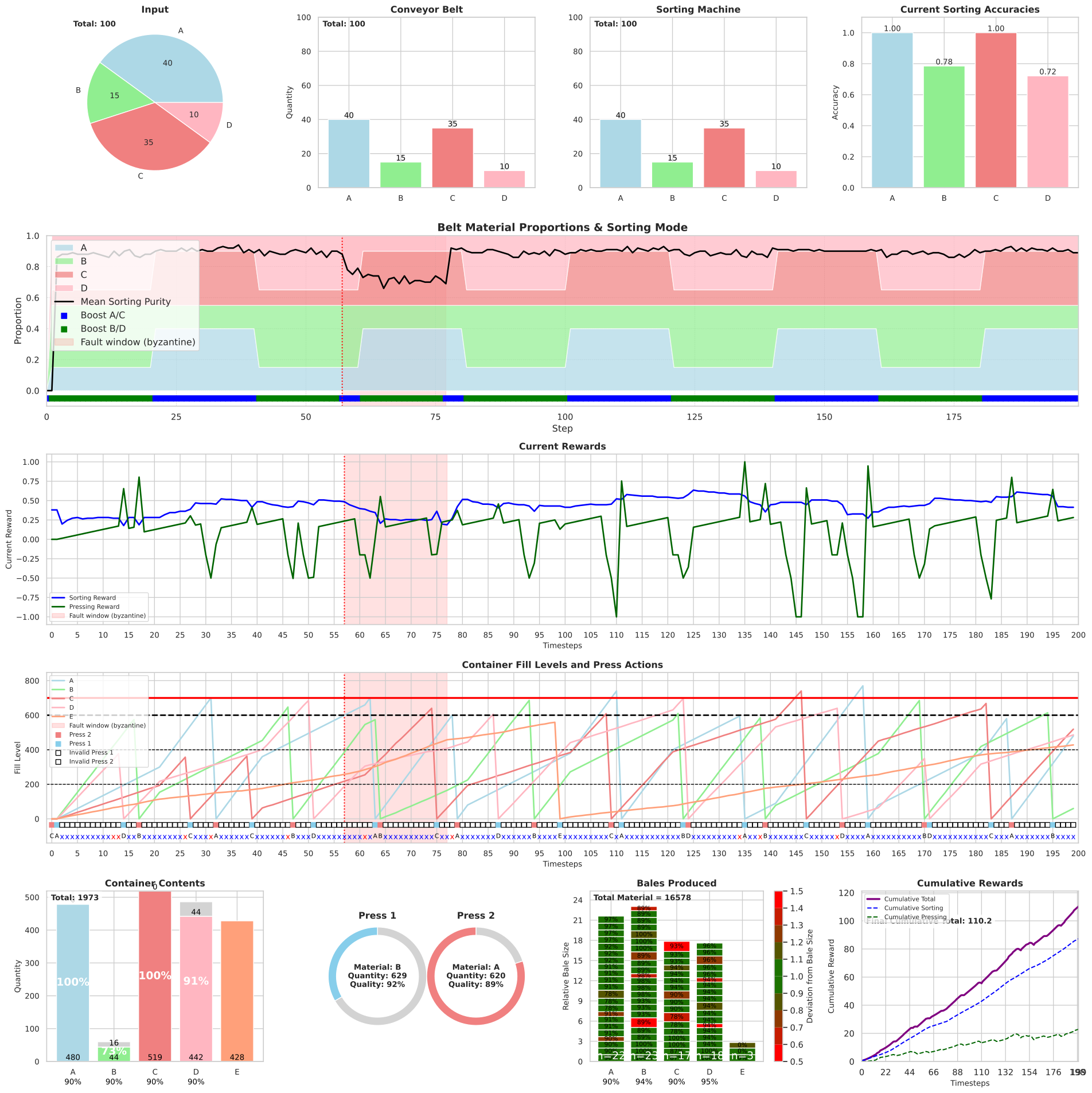
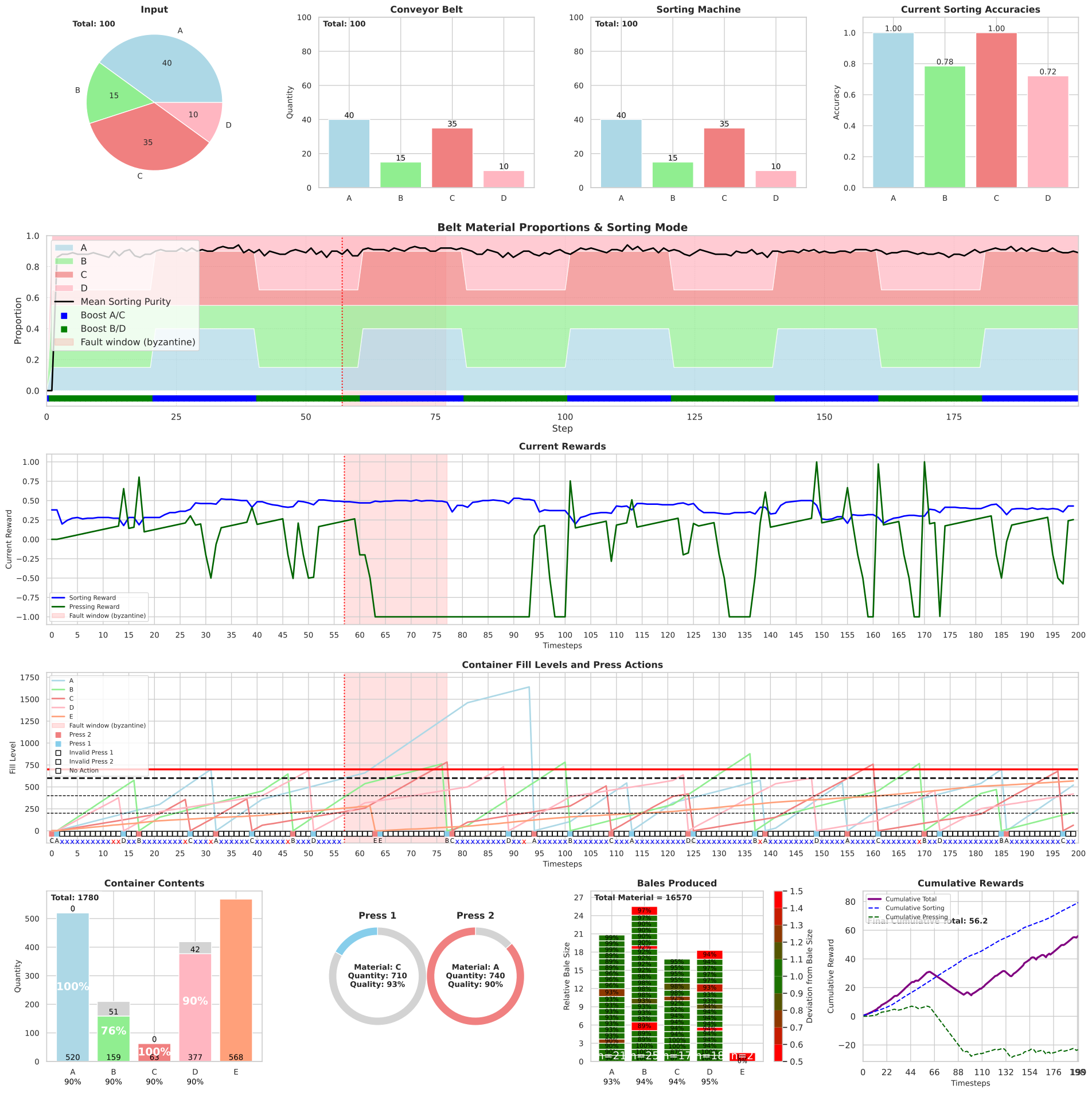
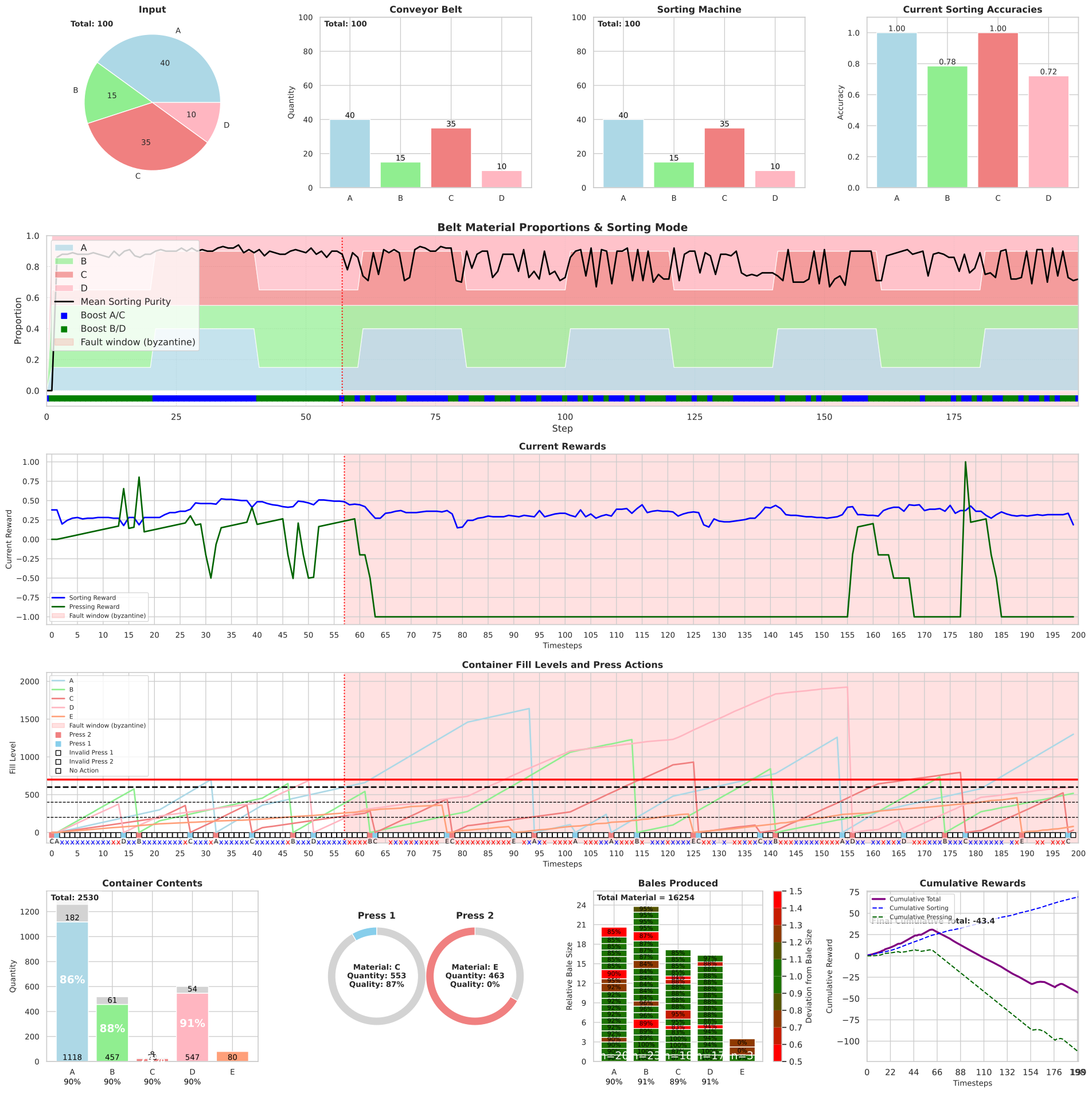
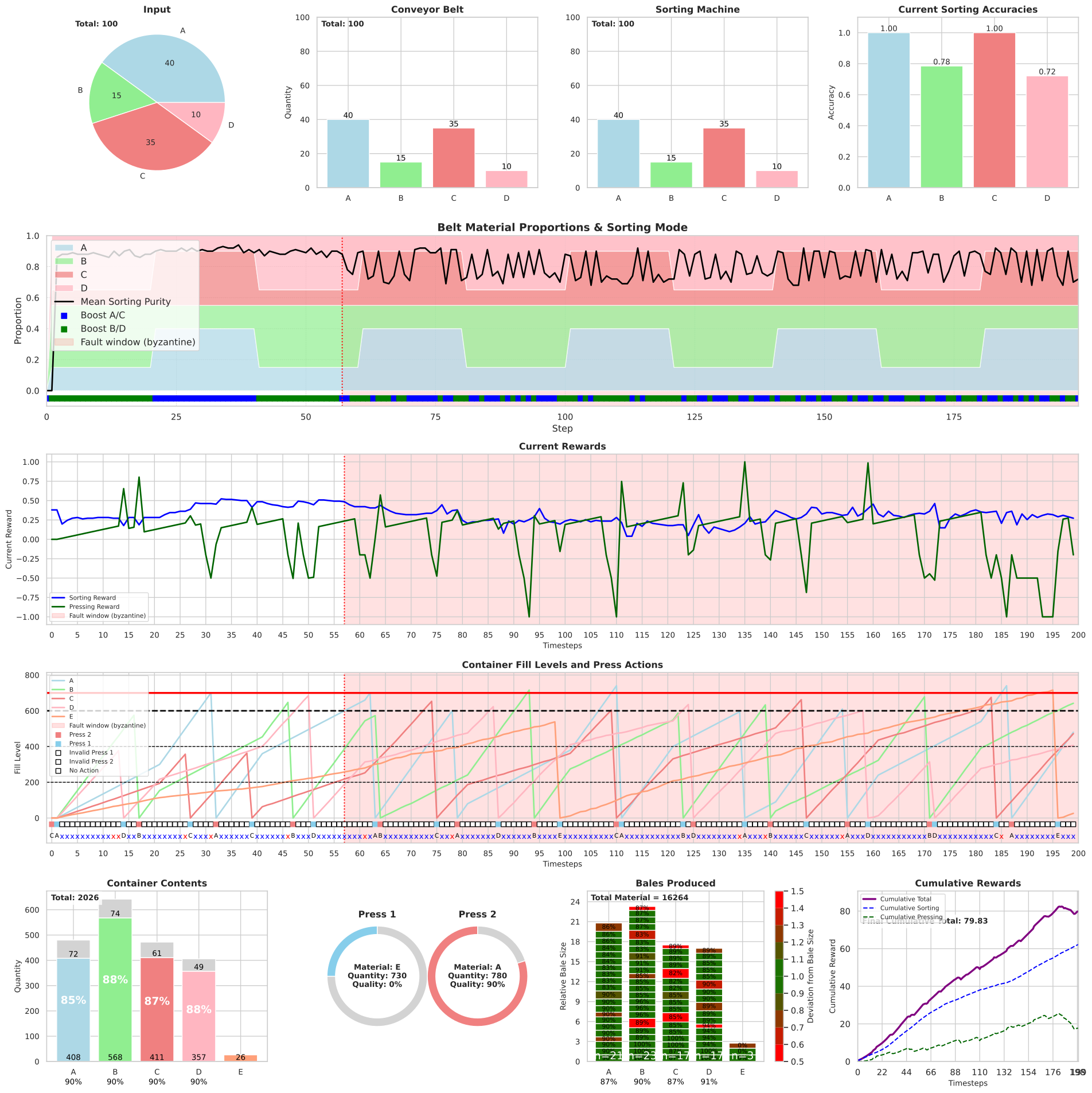
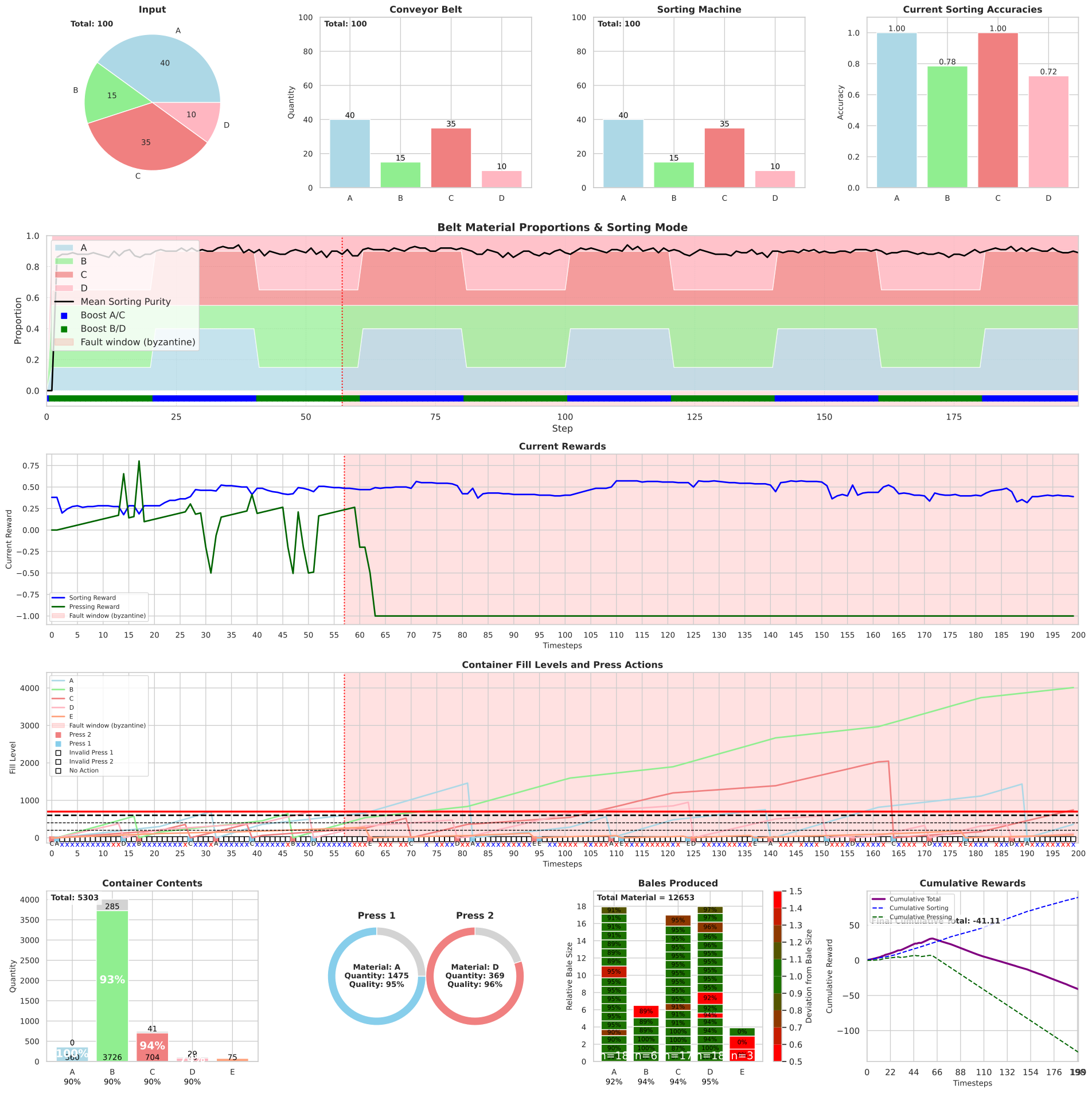
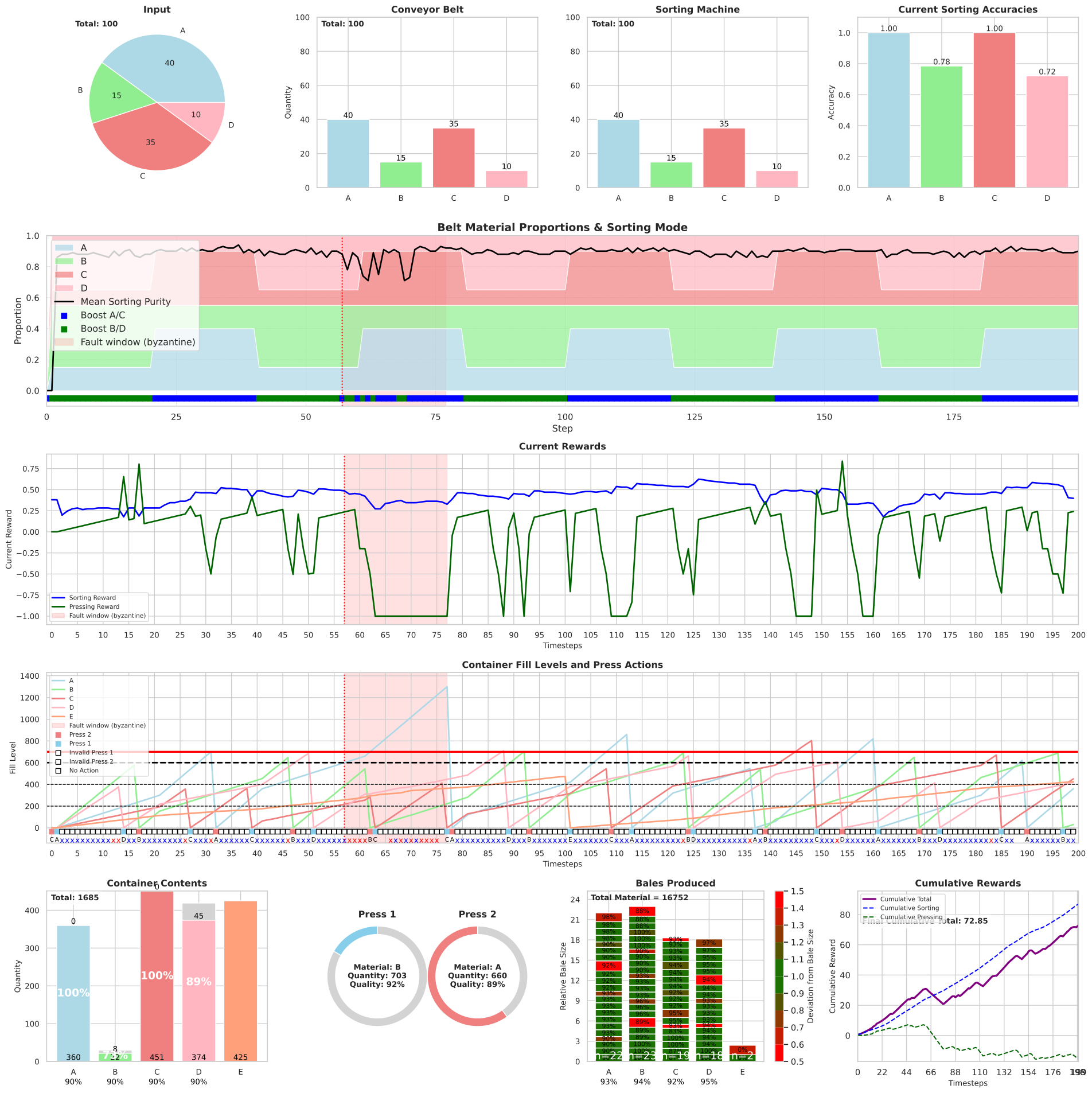
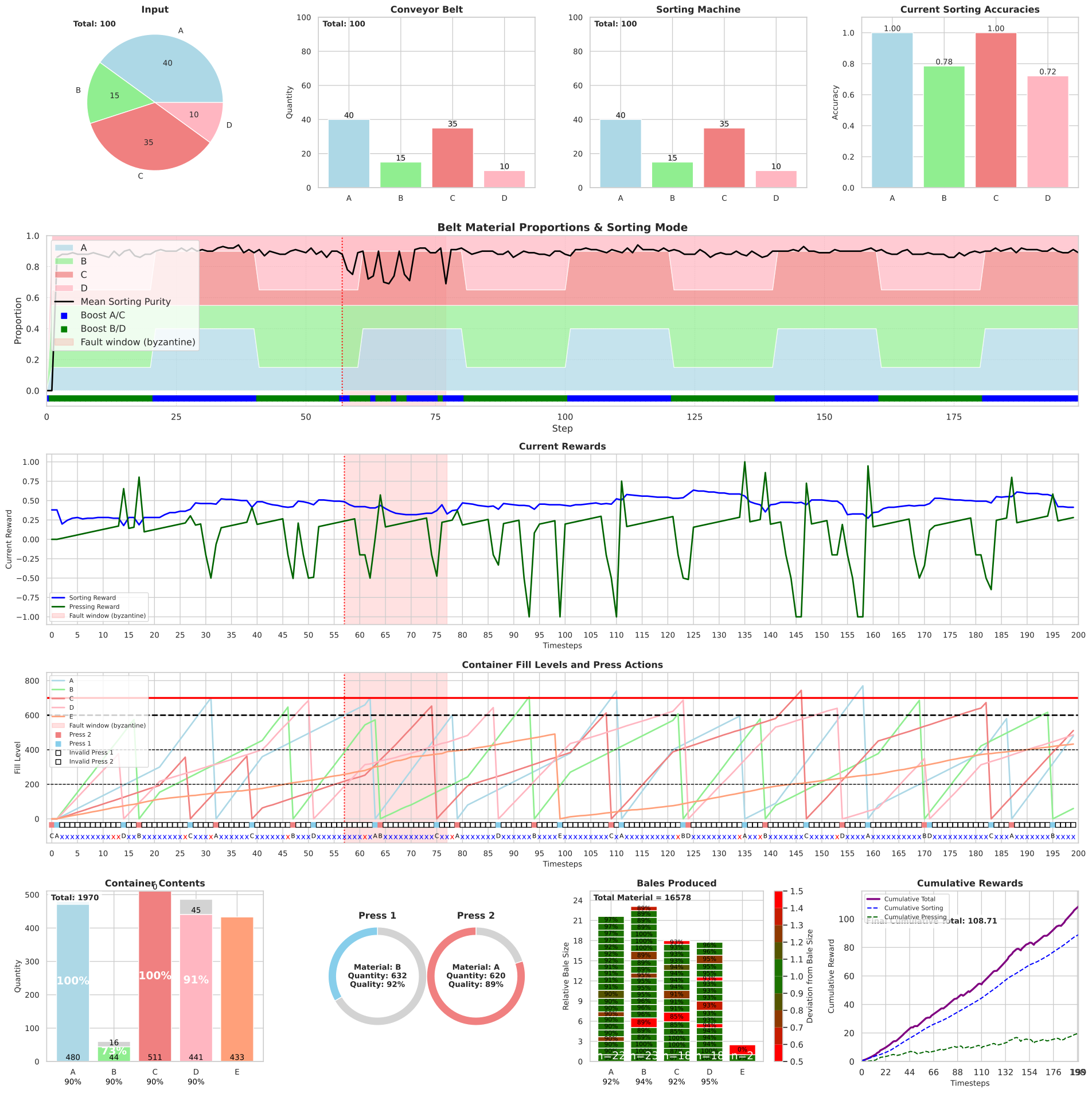
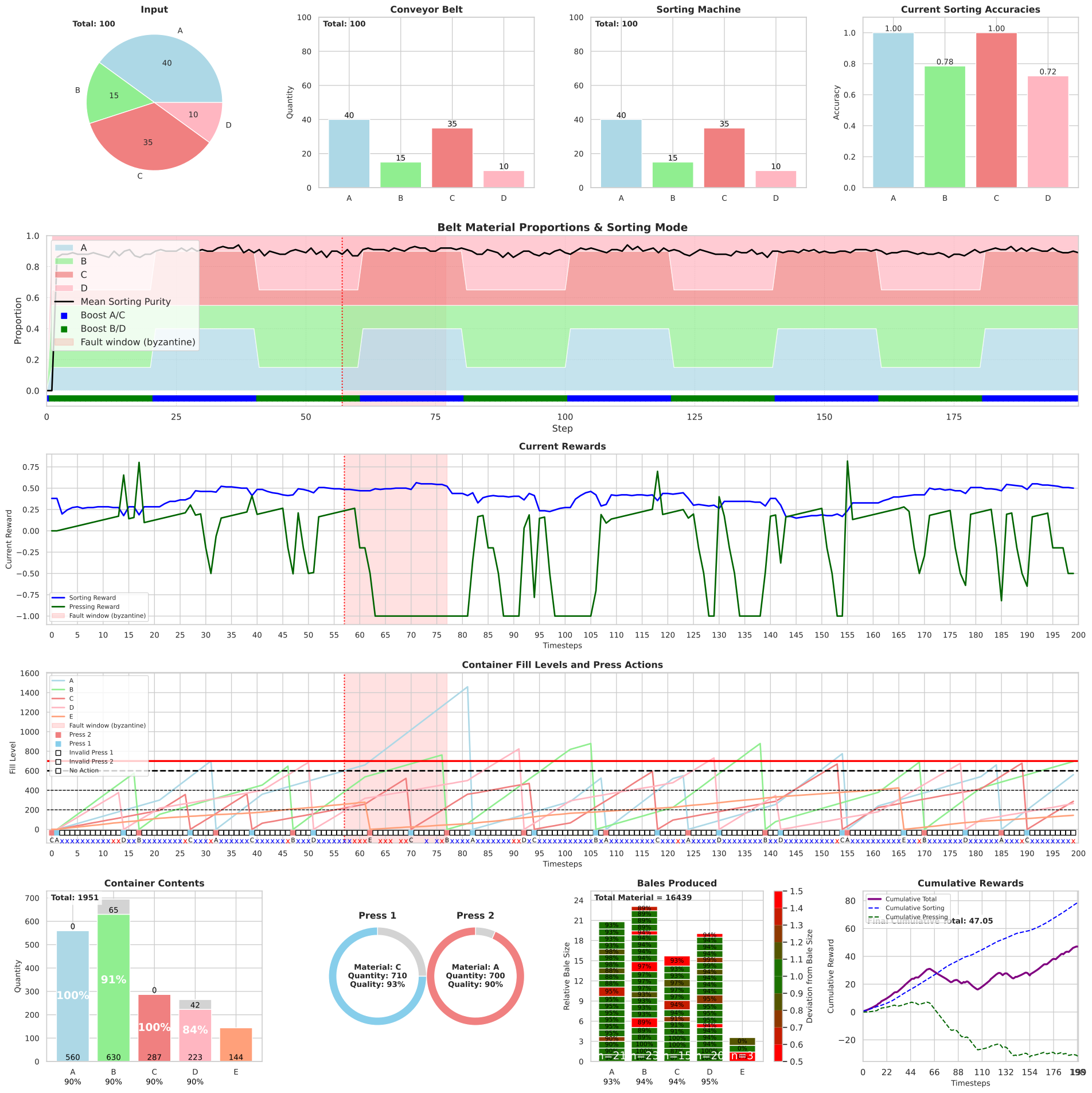
Byzantine / adversarial injection models rogue, hacked, or severely corrupted agents by swapping a cooperative agent's policy for an adversarial one at runtime (onset between steps 40-60). The compromised agent still perceives the system correctly and its commands are executed faithfully, but the decisions themselves are adversarial, in one of three modes: fixed-malicious (one harmful action chosen at onset and held), worst-action (a harmful action recomputed every step from the current state, e.g. boosting the less abundant material or pressing the emptiest container), or random-malicious (a uniformly random legal action every step). This tests whether the system can catch an agent that looks alive and plausible while preserving safety.
Experimental trajectory graphs
Fixed-Malicious Mode - Permanent Duration
Fixed-Malicious Mode - Both Agents Target (Permanent): evaluation trajectory with no recovery mechanism active (fault onset randomized between steps 40-60), seed 0 of the 8-seed sweep.Fixed-Malicious Mode - Sorting Agent Target (Permanent): evaluation trajectory with no recovery mechanism active (fault onset randomized between steps 40-60), seed 0 of the 8-seed sweep.Fixed-Malicious Mode - Pressing Agent Target (Permanent): evaluation trajectory with no recovery mechanism active (fault onset randomized between steps 40-60), seed 0 of the 8-seed sweep.
Fixed-Malicious Mode - Both Agents Target (Transient): evaluation trajectory with no recovery mechanism active (fault onset randomized between steps 40-60), seed 0 of the 8-seed sweep.Fixed-Malicious Mode - Sorting Agent Target (Transient): evaluation trajectory with no recovery mechanism active (fault onset randomized between steps 40-60), seed 0 of the 8-seed sweep.Fixed-Malicious Mode - Pressing Agent Target (Transient): evaluation trajectory with no recovery mechanism active (fault onset randomized between steps 40-60), seed 0 of the 8-seed sweep.
Worst-Action Mode - Permanent Duration
Worst-Action Mode - Both Agents Target (Permanent): evaluation trajectory with no recovery mechanism active (fault onset randomized between steps 40-60), seed 0 of the 8-seed sweep.Worst-Action Mode - Sorting Agent Target (Permanent): evaluation trajectory with no recovery mechanism active (fault onset randomized between steps 40-60), seed 0 of the 8-seed sweep.Worst-Action Mode - Pressing Agent Target (Permanent): evaluation trajectory with no recovery mechanism active (fault onset randomized between steps 40-60), seed 0 of the 8-seed sweep.
Worst-Action Mode - Both Agents Target (Transient): evaluation trajectory with no recovery mechanism active (fault onset randomized between steps 40-60), seed 0 of the 8-seed sweep.Worst-Action Mode - Sorting Agent Target (Transient): evaluation trajectory with no recovery mechanism active (fault onset randomized between steps 40-60), seed 0 of the 8-seed sweep.Worst-Action Mode - Pressing Agent Target (Transient): evaluation trajectory with no recovery mechanism active (fault onset randomized between steps 40-60), seed 0 of the 8-seed sweep.
Random-Malicious Mode - Permanent Duration
Random-Malicious Mode - Both Agents Target (Permanent): evaluation trajectory with no recovery mechanism active (fault onset randomized between steps 40-60), seed 0 of the 8-seed sweep.Random-Malicious Mode - Sorting Agent Target (Permanent): evaluation trajectory with no recovery mechanism active (fault onset randomized between steps 40-60), seed 0 of the 8-seed sweep.Random-Malicious Mode - Pressing Agent Target (Permanent): evaluation trajectory with no recovery mechanism active (fault onset randomized between steps 40-60), seed 0 of the 8-seed sweep.
Random-Malicious Mode - Both Agents Target (Transient): evaluation trajectory with no recovery mechanism active (fault onset randomized between steps 40-60), seed 0 of the 8-seed sweep.Random-Malicious Mode - Sorting Agent Target (Transient): evaluation trajectory with no recovery mechanism active (fault onset randomized between steps 40-60), seed 0 of the 8-seed sweep.Random-Malicious Mode - Pressing Agent Target (Transient): evaluation trajectory with no recovery mechanism active (fault onset randomized between steps 40-60), seed 0 of the 8-seed sweep.
Duration modes
Permanent: the fault persists until the end of the episode.